
Before you sign anything with a Medjool dates exporter, you need to know what to ask for. Malaysia has no commercial date-growing trade, so every Medjool sold here is imported. The questions below are built on the FAO date palm handbook, which describes how Medjool is grown, sorted, packed and stored for export, plus one Malaysian wholesaler's Medjool prices that I checked on 12 November 2026.
Where export Medjool actually comes from
Medjool started in the Tafilalet area of Morocco. FAO notes it was Morocco's main export date from the 17th century and was sold in gift boxes for Christmas in Paris, Madrid and London. It also records that every Medjool palm in the world traces back to one palm in Bou Denib, Morocco.
FAO's 2002 handbook put Medjool production at less than 5,000 tonnes a year at that time, against tens of thousands of tonnes of Deglet Nour.
| Producing area named by FAO | How FAO describes it |
|---|---|
| Coachella Valley and Bard, California, USA | among the main producers |
| Morocco | among the main producers; the variety's home |
| Israel | among the main producers |
| Mexico, Namibia, South Africa | small amounts |
The handbook is not a current trade map, so treat that list as a starting point. On the Malaysian wholesaler list I checked, every Medjool listing carries Palestine or Palestin in its name. Ask any exporter to put the origin country in writing on the invoice and on the pack.
If you want the bigger picture before you talk to suppliers, there is a readable overview of what makes a date-exporting country competitive, covering climate, variety choice, quality control and logistics.
How a Medjool dates exporter grades fruit
FAO describes sorting at the packinghouse in two stages. The first stage separates fruit by condition. The second sorts the best fruit by size.
| Stage 1 grade (FAO) | What it means |
|---|---|
| Grade A | perfect fruit |
| Grade B | fruit with skin separation |
| Grade C | fruit for pitting and industrial use |
| Grade D | rotten and damaged fruit |
Size sorting comes next, and FAO says it matters most for large-fruited varieties such as Medjool. In Israel, Medjool sizes are set by the weight of a single fruit: Jumbo is more than 23 g, Large is 18 to 23 g and Medium is 15 to 18 g. FAO adds that other countries, the USA for one, use different size definitions.
That is why a Jumbo label alone tells you little. Grades are each importer's own size sorting, not an international standard, so ask the exporter which definition they pack to and what the average weight per fruit is.
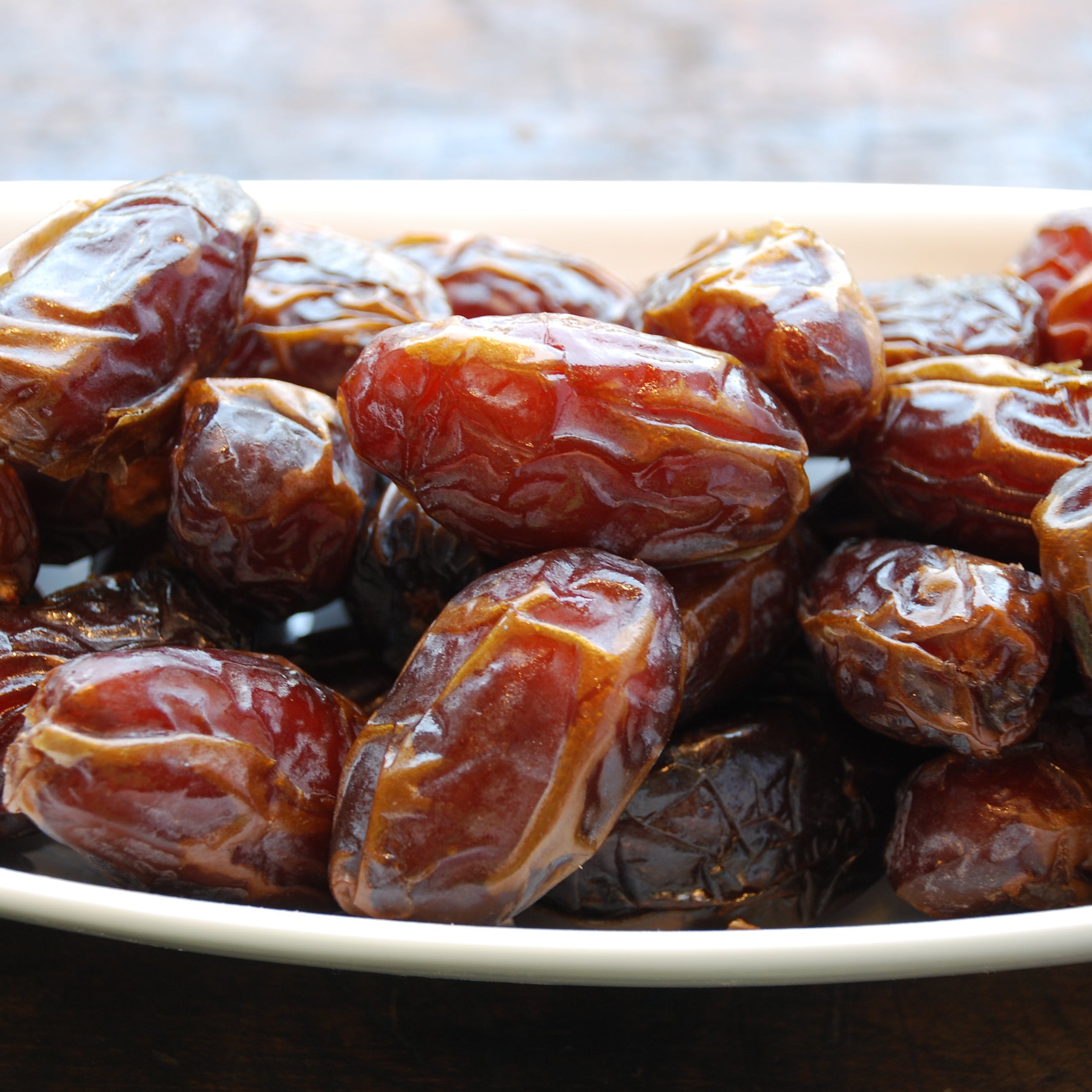
Skin separation and sugar crystals: the two defects that move price
FAO lists two main non-pathogenic defects typical of Medjool. The first is loose skin, where the skin pulls away from the flesh as the fruit loses water. FAO calls it an aesthetic defect rather than a taste defect, and fruit with more than 20 to 25 % loose skin is graded Class II.
The second is sugar crystallising, which FAO says is common in loose-skinned fruit, mainly where the skin is broken. It is also an aesthetic defect that puts fruit into Class II.
FAO is clear that fruit with skin separation has not gone bad, only that it looks worse. Price is another matter. FAO's chapter on packing says skin separation is more serious in varieties such as Medjool and significantly lowers the price of export fruit. So when an exporter quotes two prices for the same size, ask how much skin separation each lot allows.
Why Medjool costs more than most dates
The harvest is slow and hands-on. FAO describes growers in Israel wrapping the bunch in a shade net, and in Bard, California, a cloth bag, then picking the ripe fruit carefully from underneath, through the openings. FAO calls this very labour-intensive and costly, and says the high price the fruit fetches is what justifies it.
You can see the gap in Malaysian prices too. On the wholesaler list I checked on 12 November 2026, the cheapest in-stock Medjool pack worked out to RM56 per kg, while the dearest in-stock pack of any other date variety was a 1kg Safawi AAA Jumbo at RM45.
| Medjool listing (one Malaysian wholesaler, Nov 2026) | Price | Per kg | Stock |
|---|---|---|---|
| Premium Jumbo 5kg | RM280 | RM56.00 | in stock |
| Jumbo 12 packs × 500g | RM355 | RM59.17 | in stock |
| Jumbo 8 packs × 900g | RM448 | RM62.22 | in stock |
| Super Jumbo 5kg | RM315 | RM63.00 | in stock |
| Jumbo 900g box | RM70 | RM77.78 | in stock |
Four more Medjool listings on that list were out of stock: all three Large packs and a second Jumbo 12 × 500g listing at RM290. Prices change, so use these as a reference point when an exporter's landed cost comes back.
What should be printed on the pack
FAO notes that in most importing countries the law requires the weight, country of origin, quality and expiry date to appear on the package. Some packs also carry a trade label, and FAO gives KING SOLOMON as an example used for Israeli Medjool.
Ask the Medjool dates exporter for a photo of the finished pack, label included, before the goods leave. It is the cheapest check you can make.
Storage and fumigation questions
For long-term storage, FAO says the temperature commonly used for several varieties including Medjool is −18°C, and that this cuts water loss as well as sugar crystallisation and skin separation. Ask the Medjool dates exporter how the lot was held before packing and what temperature the container will run at.
Fumigation is worth one question as well. FAO's handbook names methyl bromide as the substance most frequently used, and notes it was placed under the Montreal Protocol in 1992 because of its damage to the ozone layer. Ask which method was used on your lot and get it in writing.
Once the fruit lands, holding it properly is your job. Our piece on keeping dates in good shape during transport covers the basics for businesses.
A short checklist before you order
- Origin country in writing, on the invoice and on the pack.
- The size definition used for each grade, with average weight per fruit.
- How much skin separation the lot allows.
- Storage temperature before packing and in transit.
- Fumigation method used.
- A labelled pack photo before dispatch.
Price and payment terms with a Medjool dates exporter are a separate conversation. See our notes on minimum order quantities and payment terms and on finding the right bulk dates supplier for those.
Questions buyers ask
Is Jumbo the same size with every exporter?
No. Israel defines Medjool Jumbo as more than 23 g per fruit, and FAO notes the USA uses other definitions. Ask each exporter for theirs.
Does loose skin mean the dates are spoiled?
No. FAO calls loose skin an aesthetic defect rather than a taste defect, though it does lower the export price.
Does Medjool ripen early or late in the season?
FAO describes Medjool as an early ripening variety.
More about this site is on the About Us page and the contact page.